

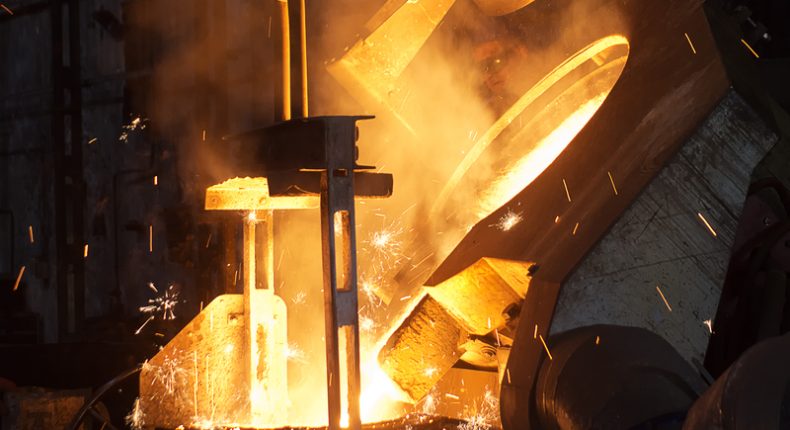
Metal casting is one of the oldest manufacturing processes in human history, yet it remains one of the most technically advanced methods used in modern industry. At its core, casting blends scientific principles such as metallurgy, thermodynamics, and material behavior with hands-on expertise, judgment, and experience.
The “art” of metal casting lies in understanding how molten metal behaves, how molds respond under heat and pressure, and how subtle process adjustments affect final part quality. The “science” comes from controlled processes, testing, simulation, and data-driven decision-making. Together, these elements allow foundries to produce complex, high-performance components used across industrial, automotive, aerospace, energy, and defense applications.
Metal casting involves pouring molten metal into a mold cavity shaped like the desired part. Once the metal cools and solidifies, the mold is removed, leaving a near-net-shape component.
While the concept is simple, successful casting depends on controlling multiple variables, including:
Mastering these fundamentals ensures structural integrity, dimensional accuracy, and consistent performance.
Different casting methods are used depending on part size, material, complexity, and production volume.
Sand casting is one of the most versatile and widely used methods. It supports a broad range of metals and part sizes and is ideal for low- to medium-volume production and large components.
Permanent mold casting uses reusable metal molds to produce parts with improved surface finish and dimensional consistency compared to sand casting. It is often used for aluminum components in higher production volumes.
Die casting injects molten metal into hardened steel dies under high pressure. This process produces excellent surface finishes and tight tolerances and is best suited for high-volume production of non-ferrous parts.
Each method requires a unique balance of engineering design, tooling, and process control.
Metallurgy is the scientific backbone of metal casting. Understanding how different alloys behave when melted, poured, and cooled is essential to producing reliable parts.
Key metallurgical considerations include:
Proper metallurgical control ensures cast components meet mechanical and performance specifications.
Mold and core design is where casting science meets practical experience. The mold must allow molten metal to flow smoothly while supporting the shape and integrity of the part during solidification.
Effective mold design focuses on:
Well-designed tooling reduces defects, improves consistency, and enhances overall casting quality.
How metal cools and solidifies has a direct impact on part quality. Uneven cooling can lead to internal stresses, shrinkage defects, or distortion.
Foundries manage solidification by:
Careful control of cooling behavior improves strength, dimensional accuracy, and reliability.
Modern metal casting relies heavily on inspection and testing to verify quality. Visual inspection alone is not sufficient for critical components.
Common quality control methods include:
Quality systems and documentation ensure castings meet industry standards and customer requirements.
While casting produces near-net-shape components, machining is often required to achieve final tolerances and functional features. CNC machining adds precision where casting alone cannot.
Machining typically addresses:
Foundries that integrate machining into their operations provide better control, faster lead times, and more consistent results.
Today’s foundries combine traditional knowledge with advanced technology to improve efficiency and quality. Simulation software, automated molding systems, and CNC machining centers allow for greater process control than ever before.
Modern advancements include:
These technologies enhance repeatability while reducing waste and production risk.
Despite technological advances, successful metal casting still depends on skilled professionals who understand the nuances of the process. Experience allows foundry teams to interpret data, make informed adjustments, and solve complex problems that software alone cannot address.
The most successful foundries balance:
This balance ensures consistent, high-quality outcomes across diverse applications.
Metal casting is both an art refined through experience and a science grounded in engineering principles. From metallurgy and mold design to solidification control and machining, every step plays a role in producing reliable, high-performance components.
Understanding the art and science behind metal casting helps manufacturers make informed decisions, improve product quality, and select the right partners for their projects. As technology continues to evolve, the fundamentals of casting remain essential, supported by innovation and expertise.

Top quality casting and services via our in-house foundry & machine shop